 Blog
Blog
Why Meyton prints so many 0.0 Teilers
In a Facebook group, someone recently asked why Meyton result lists show a 0.0 Teiler so often. If you shoot on paper, you rarely see a Teiler below 2, and at prize shoots on Meyton ranges the top three places often have a 0.0 as their best Teiler. The person asking had done the math: if a system measured shots to within 0.1 Teiler and a shooter put every shot somewhere in the 10.9, the odds of a 0.0 Teiler would be 1 in 62,500. That math assumes a circle with a radius of 0.1 Teiler. On Meyton the area that prints as 0.0 is larger, and that comes down to how Meyton systems build the Teiler.
How Meyton builds the Teiler
Meyton support explained the calculation in an email that was quoted in the Meisterschützen forum (opens in a new tab) in 2019. Meyton uses a Cartesian coordinate system with a measuring resolution of 1/100 mm, the origin sits at the center of the target, and the Teiler is calculated with the Pythagorean theorem. What the Teiler measures and how it becomes a tenth is covered in Teiler and ring score.
In Meyton’s XML export, both coordinates are whole numbers marked Resolution="100", which means hundredths of a millimeter. A shot with X = 103 and Y = 55 sat 1.03 mm and 0.55 mm from the center. For this example, √(103² + 55²) gives 116.77. The export lists the Teiler as 116, and rounding would have given 117. That holds for every shot in the Meyton exports I checked: wherever truncating and rounding give different Teilers, the export has the truncated one. The printout shows the Teiler with one decimal, 116.7 here, and that digit is truncated as well, not rounded.
Which Teilers Meyton can print
Because both coordinates are whole hundredths, only certain distances occur. A shot at (1 | 0) is exactly a 1 Teiler. One at (1 | 1) is a √2 = 1.41 Teiler and shows up as 1.4 on the printout. There is no value between 0 and 1, and Meyton support points that out in its email too. Below a 10 Teiler, these are all the values Meyton can print:
| Teiler | possible values on the printout |
|---|---|
| under 1 | 0.0 |
| 1 to under 2 | 1.0 · 1.4 |
| 2 to under 3 | 2.0 · 2.2 · 2.8 |
| 3 to under 4 | 3.0 · 3.1 · 3.6 |
| 4 to under 5 | 4.0 · 4.1 · 4.2 · 4.4 |
| 5 to under 6 | 5.0 · 5.3 · 5.6 · 5.8 |
| 6 to under 7 | 6.0 · 6.3 · 6.4 · 6.7 |
| 7 to under 8 | 7.0 · 7.2 · 7.6 · 7.8 |
| 8 to under 9 | 8.0 · 8.2 · 8.4 · 8.5 · 8.6 · 8.9 |
| 9 to under 10 | 9.0 · 9.2 · 9.4 · 9.8 |
Below a 5 Teiler, only 13 of the 50 tenths are possible. Further out the values get denser, and above roughly a 40 Teiler hardly any are missing.
The table also shows the truncation. A shot at (3 | 1) is a √10 = 3.16 Teiler and shows up as 3.1 on the printout. Rounding would give 3.2, and that value isn’t in the table. On your own Meyton printouts you’ll find small Teilers like 3.1 or 4.4, and you won’t find a 3.2 or 4.5.
Why 0.0 comes up so often
Every shot whose two coordinates both become 0 gets a 0.0. The support email calls (0/0) a perfect hit. It doesn’t say whether Meyton truncates or rounds the coordinates to get there. In Meyton exports, 0 shows up as a coordinate about twice as often as 1 or 2, and that fits truncation. In that case a shot sitting 0.009 mm right of and 0.009 mm above the center becomes (0 | 0) and prints as 0.0. Its distance from the center is √(0.9² + 0.9²) = 1.27 Teiler. Everything inside a 0.02 × 0.02 mm square around the center becomes a 0.0, and in the corners of that square a shot can sit up to 1.41 Teiler off center.
Take the shooter from the math above, who puts every shot somewhere in the 10.9. On an air rifle target the 10.9 is a circle with a radius of 25 Teiler, see the air rifle Teiler table. The square for the 0.0 is 2 Teiler wide and covers one 491st of that circle. So on Meyton, about every 490th shot in the 10.9 is a 0.0. The square is 127 times the size of a circle with a radius of 0.1 Teiler. On a paper target, a Teiler up to 1.13 is just as common, because a circle with that radius has the same area as the square.
If Meyton rounded the coordinates instead, the square would be only 1 Teiler wide, and the 0.0 would come up once in every 1,963 shots in the 10.9. That is still 32 times as often as with a measurement accurate to 0.1 Teiler.
The more shots land in the 10.9, the more often a 0.0 shows up somewhere. From about 500 shots in the 10.9 you can expect one 0.0 on average, and with 1,500 it’s three. In the same email, Meyton support also credits more precise guns and ammunition for the growing number of perfect shots. That raises the share of shots in the 10.9 and with it the number of 0.0 Teilers.
Why a 0.0 still has an arrow
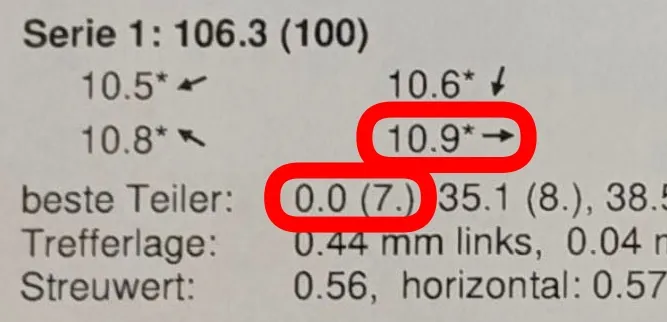
Many Meyton printouts show an arrow next to each shot for the direction of the deviation, including next to a 0.0. You can’t read a direction from (0 | 0). The way I read it, Meyton calculates with decimals internally and only truncates to whole hundredths for the display, the printout and the export. The arrow then comes from the value before truncation. I have no confirmation from Meyton on this.
What this means for king’s shoots and prize shoots
Meyton states an accuracy of at least 1/10 millimeter (opens in a new tab) for its measuring frame, which is a 10 Teiler. The difference between a 0.0 and a 1.4 is far below that tolerance. The ranking still uses the printed value, and when several shooters have a 0.0, the match rules decide. The second-best Teiler or a shoot-off are common.
Frequently asked questions
Is a Meyton 0.0 a shot dead in the center?
A 0.0 means the shot was less than 0.01 mm from the center on both axes. That can be up to a 1.41 Teiler. Hardly any of them sit exactly in the center.
Which Teilers under 5 can Meyton print?
0.0 · 1.0 · 1.4 · 2.0 · 2.2 · 2.8 · 3.0 · 3.1 · 3.6 · 4.0 · 4.1 · 4.2 · 4.4. No other values exist in this range, because Meyton reports the position in whole hundredths of a millimeter and truncates the Teiler.
How accurate is a Meyton system?
Meyton states an accuracy of at least 1/10 mm, which is a 10 Teiler. According to Meyton support, the measuring resolution is 1/100 mm, which is a 1 Teiler.
How to import your results from Meyton systems (printouts, PDFs and QR codes) into Ring Reader is covered in Import Meyton results.
Import your Meyton results and see every Teiler in your training diary.
Try it