 Blog
Blog
Teiler and Ring Score: The Numbers That Show You Where to Improve
Here is a shot from a 10-target strip at our club: the SAM 4000 scoring machine printed 10.5 — 129.2 Teiler next to it (left target). Run that same 129.2 Teiler through the official ISSF decimal formula, and you get a 10.4.
But the 10.5 is not really wrong, because the SAM 4000 applies a perfectly defensible rule. If you have ever compared results from two systems and wondered which one to trust, or what your Teiler values actually mean, this article is exactly for you.
We will cover what the Teiler and decimal scoring are, how the conversion works, why different systems can land on a different tenth — and above all: how to read your own Teiler values to find out where you can improve.
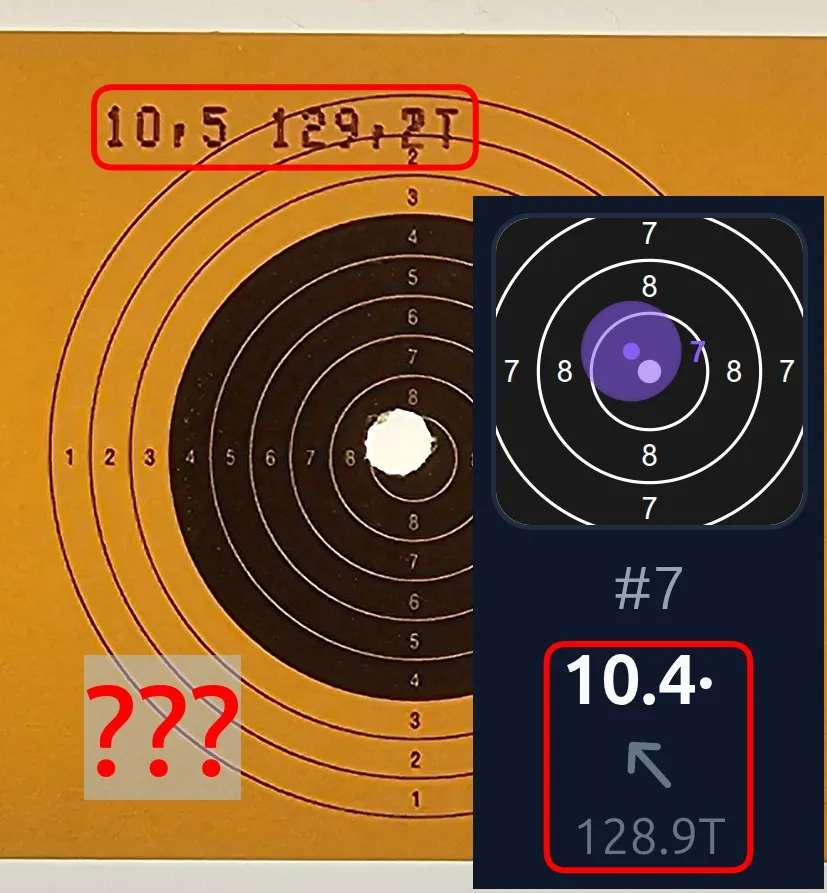
On the right of the image: the same shot, photographed and scored by Ring Reader — 10.4 at a 128.9 Teiler. Remember those numbers; by the end of this article you will know why all three results are correct.
What is a Teiler?
The Teiler is the unit for how far a shot lands from the center of the target — a concept from German shooting sport with no direct English equivalent. The idea is simple:
1 Teiler = 0.01 mm of deviation from the target center.
A shot exactly in the center is a 0 Teiler — the perfect shot. A shot 5.00 mm from center is a 500 Teiler. The lower the Teiler, the better.
One property makes the Teiler special: it is a pure distance. It does not depend on the caliber, on ring sizes, or on any scoring convention. It is measured from the target center to the center of your hit, period. That becomes important later, because the ring score does not share this property.
The ring score (say 10.5 or 9.7) tells you which scoring zone the shot landed in. The Teiler tells you how far from center it landed — a much finer measurement.
Why the Teiler matters more than you think
Two shots can both be a 10.9 — but one sits at a 4 Teiler (almost perfectly centered), the other at a 24 Teiler (at the outer edge of the 10.9 zone). The ring score alone cannot show the difference; at 10.9 the scale ends. The Teiler can.
That is why in many clubs the Teiler decides Teiler rankings, best-shot lists, Glücksscheiben, and prize shoots. It is the precision metric that the ring score alone cannot provide.
The math: how Teiler become decimal rings
The examples in this section refer to the 10 m air rifle target. Air pistol and smallbore are covered further below, because the numbers differ there.
The geometry
- The ten ring has a diameter of 0.5 mm, so its radius is 0.25 mm = 25 Teiler.
- The ring spacing is 2.5 mm = 250 Teiler.
- The 4.5 mm caliber means a pellet radius of 2.25 mm = 225 Teiler.
The decisive point is the edge rule: a shot counts 10.0 when the outer edge of the shot hole just touches the ten-ring line. That is the case exactly when the center of the shot hole lies at 25 Teiler (ten-ring radius) + 225 Teiler (pellet radius) = 250 Teiler. So each full ring spans 250 Teiler of center distance, and each tenth step spans 25 Teiler.
One formula for everything
The formula to compute the decimal value from the Teiler is:
Decimal value = 11 − (Teiler / 250), truncated to one decimal, capped at 10.9The fraction alone would give 11.0 for a 0 Teiler, hence the cap at 10.9. The result is then cut off after one decimal place. It works for every ring: a 375 Teiler gives 11 − 1.5 = 9.5. As a table:
| Teiler range | Value |
|---|---|
| >0–25 | 10.9 |
| >25–50 | 10.8 |
| >50–75 | 10.7 |
| … | … |
| >225–250 | 10.0 |
| >250–275 | 9.9 |
| … | … |
Cut off, not rounded
The ISSF rulebook defines decimal scoring by dividing each ring band into ten equal zones (ISSF rules, section 6.3.3.1). The common interpretation: a shot has the value of the zone it lies in. Values are therefore truncated, never rounded up.
A shot that computes to 10.19 is a 10.1, not a 10.2. You only get the next tenth once your shot hole has fully reached it. This gives the mapping from Teiler to ring score hard boundaries — and exactly at those hard boundaries, different systems can diverge.
Same shot, different tenth: why systems can diverge
First the reassuring part: on most shots, all systems agree. Another shot on the same strip shows 10.6 — 93.2 Teiler, and a 93.2 Teiler comes out as a 10.6 under every convention in use. Differences only appear when a shot lies close to a tenth boundary, and they trace back to two independent design decisions. Both are legitimate — and still cause confusion at times.
Design decision 1: calculating with a 4.6 mm caliber
The edge rule needs a pellet radius, and not every system calculates with 4.5 mm. Plenty of shooters use 4.49 mm or 4.51 mm pellets anyway. The SAM 4000, for example — a scoring machine that has served many clubs reliably since the 1990s — works with 4.6 mm by default (SAM 4000 manual, p. 25). As I noted in a thread on meisterschuetzen.org (opens in a new tab), the extra 0.1 mm acts as a tolerance buffer: a machine that measures shot hole positions physically always has some measurement uncertainty, and the wider assumed caliber gives the shooter the benefit of the doubt at the boundary. It also accounts for the permitted printing tolerances of the paper targets. A deliberate, shooter-friendly decision.
The effect: the pellet radius grows from 225 to 230 Teiler, and with it every scoring boundary moves outward by 5 Teiler: the 10.0 boundary from 250 to 255 Teiler, the limit between 10.5 and 10.4 from 125 to 130 Teiler, and so on. A shot measured as a 252 Teiler is a 10.0 with 4.6 mm, and a 9.9 by the strict ISSF standard with 4.5 mm.
And that is exactly what explains our opening example: a 129.2 Teiler lies 0.8 Teiler below the shifted 10.5 limit of 130. On the SAM 4000 with its configured 4.6 mm caliber that makes a 10.5; with 4.5 mm (limit at 125) it would be a 10.4. No error, no rounding trick: the same distance, a different caliber assumption. The same at a 52 Teiler: a 10.7 by ISSF, a 10.8 with the 5-Teiler shift — because the 10.8 zone then runs from 30 to 55 Teiler.
For the very precise: inside the ten there is in theory a second reading — dividing the enlarged span of 255 Teiler into ten equal zones would make each tenth 25.5 Teiler wide and put the 10.5 limit at 127.5. But scoring machines from the era of plug gauges calculate like the gauge: all boundaries shifted by the constant radius increase, tenth zones staying 25 Teiler wide, with only the innermost 10.9 zone growing (0 to 30 Teiler). The examples above match this constant shift exactly.
Design decision 2: round or truncate
The second lever is what happens to the computed value. The ISSF interpretation truncates: a computed 10.483 (for example a 129.2 Teiler under 4.5 mm math) becomes a 10.4. A system could instead round to the nearest tenth — then the same 10.483 would become a 10.5. Note the direction: rounding can only ever deliver the same tenth or a better one, never a worse one.
For the examples in this article we do not need rounding — the 5-Teiler shift explains them completely. But if you run into discrepancies on your system that no caliber shift can explain, rounding is the second candidate.
Check it on your own printout
A nice exercise with a DISAG result:
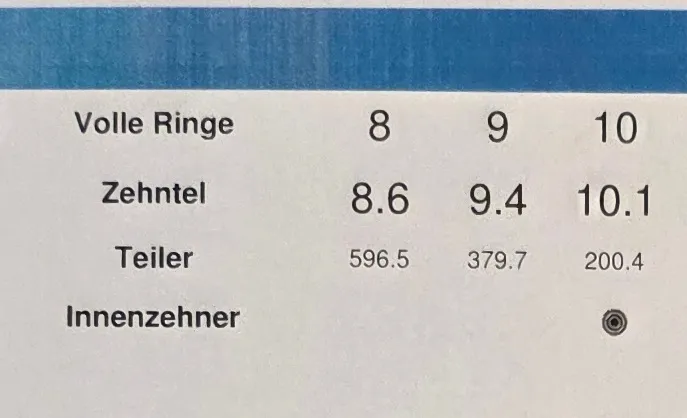
- 200.4 Teiler → 11 − 0.8016 = 10.198 → displayed: 10.1. Rounding would have shown 10.2, and so would the 5-Teiler shift of a 4.6 mm caliber (the 10.2 zone would then reach to 205 Teiler).
- 379.7 Teiler → 11 − 1.5188 = 9.481 → displayed: 9.4. Rounding would have shown 9.5, and so would the 5-Teiler shift (the 9.4 zone would then only start at 380 Teiler).
So this DISAG follows the ISSF convention exactly: 4.5 mm caliber, truncated. You can run this check yourself on any result screen and any printout that shows the decimal value and the Teiler together. The Teiler calculator does it faster, and you can enter a 4.6 mm projectile diameter there too.
The takeaway is not that one system is right and the other is not. Each is consistent within itself, and within one system your results are always comparable. Just be aware of the conventions when you compare a tenth across systems. A shot close to a Teiler boundary can perfectly legitimately carry a different tenth on different displays, while the Teiler stays the same. Which brings us to a rule worth memorizing:
Calculating with a different caliber or rounding changes the ring score. It does not change the Teiler. If two systems show different Teiler values for the same shot, that is measurement scatter — not a difference in calculation.
Not all Teiler are equal: the discipline counts
A Teiler is a pure distance — and target geometries differ enormously between disciplines. The same 110 Teiler is:
| Discipline | Ten-ring Ø | Ring spacing | Caliber | Full ring = | 110 Teiler = |
|---|---|---|---|---|---|
| Air rifle 10 m | 0.5 mm | 2.5 mm | 4.5 mm | 250 Teiler | 10.5 |
| Air pistol 10 m | 11.5 mm | 8.0 mm | 4.5 mm | 800 Teiler | 10.8 |
| Smallbore 50 m | 10.4 mm | 8.0 mm | 5.6 mm | 800 Teiler | 10.8 |
(For air pistol and smallbore the formula is accordingly 11 − Teiler/800.) The full tables have posts of their own: air rifle, air pistol and smallbore.
So compare Teiler only within one discipline. A pistol shooter’s 300 Teiler and a rifle shooter’s 300 Teiler are completely different achievements. Some club competitions use a normalization factor (commonly the pistol Teiler divided by 2.6 to 3.0) to make Teiler comparable across disciplines. But that factor varies with the competition rules.
What your Teiler reveals about your shooting
The average Teiler is the signal, the best Teiler the highlight
Your best Teiler of the day makes the best-shot list, but it is a single lucky draw from your distribution; even an inconsistent series occasionally puts one shot close to the center. (A public prize shoot at our club was won last year with a 1.6 Teiler — in a series of 68 rings.) The number that truly reflects your precision is the average Teiler over a series or a training session. If your average drops over the weeks, you are genuinely getting closer to the center. That is improvement you can see long before it shows up in the ring total.
Compare against your own baseline
There is no universally “good” Teiler. A supported-position shooter, a league air rifle shooter, and someone in their first season live in completely different Teiler ranges, and all three can improve or stagnate within their own range. The useful questions are relative: What is your typical average? Is today inside your normal range or outside it? Is last month’s trend pointing toward the center? A session that would be a breakthrough for one shooter is an alarm signal for another. Measure your numbers against your own history, not against an absolute scale.
Teiler and group size together tell the whole story
They are related but different metrics:
- The Teiler measures the distance from the target center and is closely related to the mean point of impact (MPI).
- The group size measures how far your shots are from each other.
Only the combination delivers the diagnosis:
- Tight group, but consistently high Teiler: your shots land reproducibly close together, just not in the center. That points to adjusting your sights. Your technique is good. How many rings that costs shows up in the corrected score.
- Individual shots with very low Teiler, but a wide group: you can find the center, just not repeatably. That points to work on your consistency: position, trigger release, breathing rhythm.
- Tight group at low Teiler: that is the goal. Enjoy it.
The short version of this diagnosis is in the guide chapter What Do Your Numbers Say?.
How Ring Reader handles Teiler
For photographed targets, Ring Reader measures the position of every shot hole center and reports the Teiler as the raw center distance: distance in mm × 100, exactly as defined above. The decimal value is then calculated by the ISSF convention: the discipline’s official caliber, the edge rule, truncated. So Ring Reader gives you the same answer as an ISSF-conforming system.
The opening image shows it concretely: for the shot the SAM 4000 measured as a 129.2 Teiler, the photo recognition finds a 128.9 Teiler — a difference of 0.3 Teiler, three thousandths of a millimeter. And the decimal value of 10.4 is exactly what the ISSF math prescribes for that distance.
For imported results (Meyton, DISAG, Sport Quantum, and others), Ring Reader takes over ring scores and Teiler exactly as your system reported them. No recalculation, no “correction”. The number the machine at your club printed is the number in your Ring Reader history.
And when a source delivers ring scores but no Teiler, Ring Reader estimates the distance from the scoring zone — and clearly marks it as an estimate. Estimated values never compete in Teiler rankings or personal records. A best-shot list is only meaningful if every entry was actually measured.
Five points for practice
-
Read both numbers. The ring score says what you scored; the Teiler, how close to the center you really were. Two identical ring scores can hide very different shots.
-
Track your average Teiler over time — measured against your own baseline. It is a more sensitive improvement metric than the ring total and a more honest one than your best shot of the day.
-
A boundary shot can carry a different tenth on different systems. A different caliber and rounding-vs-truncating shift the ring score, never the distance from the center of the target. That is a design difference, not an error.
-
Compare Teiler only within one discipline. 250 Teiler are the entire ten zone on the air rifle target, and not even a third of it on the air pistol target.
-
Use Teiler (or MPI) and group size together for diagnosis. Tight group with consistently high Teiler: adjust your sights. Individual near-center shots in a wide group: work on your technique.
Conclusion
Teiler and ring score are two perspectives on the same shot. One tells you which zone you hit under a particular set of conventions; the other tells you how far from the center you were. If you understand both, and know which one changes when systems disagree, you see your own shooting much more clearly.
Next time you look at your Teiler values, do not just skim them. Ask what they say about your trend, your consistency, your sights. The answers are in the numbers. You just have to know how to read them.
Photograph your next target and see the Teiler of every single shot in Ring Reader — measured from the shot hole positions, scored to the ISSF standard. No download, no account. Just try it.
Open Ring ReaderSources & further reading
- ISSF Rule Book 2026 Edition, Rule 6.3.3.1 (p. 194) (opens in a new tab) — Decimal ring scoring definition
- SAM 4000 manual, page 25 (opens in a new tab) — Caliber setting (4.6 mm)
- meisterschuetzen.org thread: “Teiler zu Ringe rechnen” (opens in a new tab) — Community discussion on Teiler-to-ring conversion
- Ring Reader Blog: Scoring Targets: How to Calculate Your Ring Count