 Blog
Blog
What would the series have scored without the sight error?
After every series with a shot picture, Ring Reader works out what the same shots would have scored had the group sat in the center. The number lives on the result page in the “MPI Offset” card, on the “Corrected” line (MPI: Mean Point of Impact). The plus on that line is the share that comes down to your sights. A wide group stays wide after the shift, and the number does nothing about that. So this is only about where the group sits, not how far it spreads. How to tell the two apart is in the chapter What Do Your Numbers Say?.
Where the number is
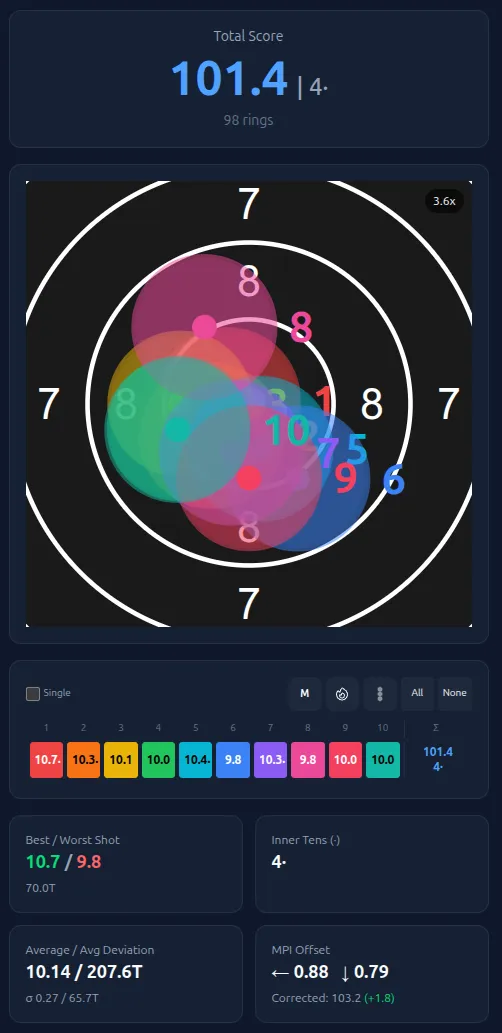
Open a result that has a shot picture. Below the target, in the row with the shot numbers, sits a small button with an M. Its tooltip reads “Mean Point of Impact”. Tap it and an orange dot appears where your series hit on average. If it sits low and left of center, the whole series pulled that way, even when every single shot looks fine on its own.
Further down come the stat cards. “MPI Offset” gives the distance from that dot to the center of the target in millimeters, sideways and in height separately, each with its direction. Below it comes a line such as “Corrected: 103.2 (+1.8)”. The 103.2 is the score the same series would have reached with the group centered, and the green number in parentheses is the difference from what you shot. If you shoot the discipline with whole-ring scoring, the line shows whole numbers, and it only appears once at least one full ring would be added. The line also goes onto the score card when you share the result. The other buttons in the row are described in the chapter View the Result.
What the number means
Ring Reader takes every shot in the series, moves it by exactly the distance the mean point of impact sits from the center, and scores it again at the new spot. The sum is the corrected score. The shots stay the same and keep their distance from each other. How a position on the target turns into a decimal score is covered in Teiler and ring score.
When a series sits off-center as a whole, its rings are lost to the sights. For the 101.4 in the example that was 1.8 rings, with the point of impact 0.88 mm left and 0.79 mm low. You get that share back with a few clicks on the diopter or the rear sight, without shooting any differently.
What the number leaves open
The corrected score does not tighten a wide group. If your shots spread over three rings, they spread just as much after the shift, only around the center. The plus then comes out small even though the score was weak. For that case the same page has the “Group Size” and “Mean Radius” cards. They describe how tightly you hit, and a sight correction changes nothing about them.
The line also needs a shot picture, meaning a photographed target or an import with shot positions. If an import only brings ring values, the card stays empty. Individual shots without a position keep their original score in the calculation.
The archive: “Rings left on the table”
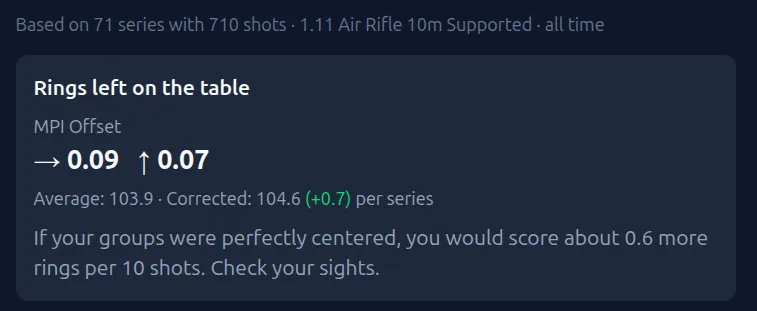
The same question can be asked across all series of one discipline. In Analytics you pick “Insights” (Pro) as the chart type and the discipline family above it. One of the six cards is called “Rings left on the table”. It re-scores every series centered, the way the result page does, and averages the gain per 10 shots. As long as fewer than five series with a shot picture have come in, it shows “Not enough data yet (3 of 5).” After that the card only reports a finding when it holds up statistically across the series and amounts to at least half a ring per 10 shots, along these lines: “If your groups were perfectly centered, you would score about 0.8 more rings per 10 shots. Check your sights.” If your groups sit in the center on average, the card says that too. Shots with only an estimated position are left out. What the other five cards evaluate is in the chapter Statistics & Trends.
Frequently asked questions
Why does my series show no “Corrected” line?
Most of the time the group already sits in the center. If the shift does not change the score by even a tenth, the line stays away. With whole-ring scoring it only appears once a full ring would be added. Without a shot picture there are no positions to shift; that applies to imports that only bring ring values.
Should I adjust the sights right after a series with +1.8?
Check first whether the offset stays. In Analytics, the “MPI Deviation” view shows each series’ point of impact as a dot on a target and its course over time. If it points in the same direction series after series, the sights are worth a look. With a point of impact that jumps somewhere else from series to series, every correction only chases the last coincidence, and the next series lands elsewhere again.
Does the corrected score count anywhere?
No. It is never stored. Ring Reader recalculates it on the result page, on a group’s page and for the score card each time. Records and challenges work with the score you shot.
Open your last series and tap the M.
Take a look